
Qualified Opportunity Zones have been part of the tax-planning conversation for several years. Beginning January 1, 2027, the rules change in ways that matter if you expect a large capital gain.
The One Big Beautiful Bill Act (OBBBA), signed into law on July 4, 2025, made the Opportunity Zone incentive permanent and set up a new framework for investments made from 2027 on. New zones will also take effect that year, with fresh rounds of designations every 10 years after that.
When you realized your gain can make a real difference:
If you realized a capital gain before July 2026, your investment deadline depends on when and how that gain was recognized. If you’re still within the applicable investment window, investing before the end of 2026 generally means following the original Opportunity Zone rules, with deferred gains becoming taxable for the 2026 tax year.
If you realize a gain after July 2026, you generally have 180 days to invest in a Qualified Opportunity Fund (QOF), or longer if the gain is passed through from a partnership on a Schedule K-1. Because that window can run into 2027, you may be able to invest under the new rules.
If you already own an Opportunity Zone investment
If you invested in a QOF under the original rules, one date is coming up fast. Under those rules, deferred gains are generally taxed on the earlier of the date you sell the investment or December 31, 2026. For many investors, that means the tax on the deferred gain will be due with their 2026 return.
If that’s you, it’s worth confirming now how much gain you’ll recognize and how you plan to pay for it. It’s also a natural moment to ask what you want to do with the investment from here.
How deferral works under the new rules
Under the original program, eligible gains invested in a QOF could be deferred until an inclusion event or December 31, 2026, whichever came first.
Starting in 2027, deferral is tied to when you invest. Eligible gains put into a QOF can generally be deferred until the earliest of an inclusion event, a sale or exchange of the investment, or five years after the investment date. If you hold the investment for at least five years, current law gives you a 10% basis increase, which reduces the amount of the original gain that’s taxed.
Here’s a simple illustration:
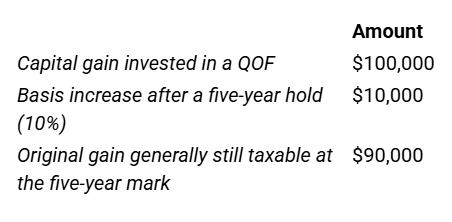
This is a hypothetical example, for illustration only. The tax on the remaining gain generally comes due at the earliest inclusion event or five years after you invest, so it’s worth planning for how you’d pay it. Some investment strategies may build into their approach a potential distribution or return of capital at year five to help pay this tax.
The 180-day window
To qualify, an eligible gain generally has to be reinvested in a QOF within 180 days of when you realized it. For a sale of property or securities, the clock usually starts on the sale date.
It’s a firm requirement, and one reason these conversations go better before a sale than after.
The new rules apply to investments made after December 31, 2026. So a gain realized in the second half of 2026 may have a 180-day window that runs into 2027, which can allow it to be invested under the new framework. Gains passed through from a partnership may have a longer window. Because the dates depend on when and how the gain was realized, this is one to review closely with your tax advisor.
The benefit many investors should pay more attention to
Deferral is only part of the picture.
If you hold your QOF investment for at least 10 years, you may be able to elect to step your basis up to its fair market value when you sell. In plain terms, the growth you earned inside the fund may be excluded from federal capital gains tax. Under the new rules, that step-up applies to holding periods of up to 30 years.
A second illustration:
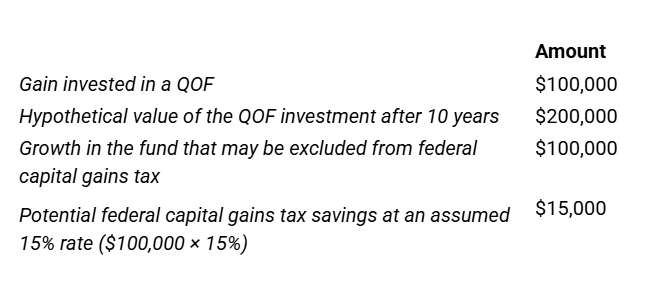
This hypothetical example is for illustration only and does not project future results. It assumes the investment is held for at least 10 years, the applicable requirements are met, and the investor makes the required election. The $15,000 represents potential federal capital gains tax savings on the growth of the QOF investment. The original deferred gain is treated separately, as described above.
A benefit like that can be appealing. But it only matters if the investment itself does well, which is why the section on risk below matters as much as the tax rules.
The map is changing, too
New zones will be selected by state governors and certified by the Treasury every 10 years, with the first group taking effect in January 2027. The standards are tighter than before. A census tract generally has to have income below 70% of the area median, or a poverty rate above 20%, and the exception that let some neighboring higher-income tracts in has been removed. Some analysts expect fewer tracts to qualify than today.
There’s a transition period as well. Existing zones generally stay valid through December 31, 2028, and tracts that meet the new standards can be re-designated. How the overlap applies to a new investment is worth confirming with your tax advisor and the fund’s offering documents. New reporting requirements, with penalties for non-compliance, begin with the 2027 tax year.
Rural zones are getting extra attention
Qualified rural opportunity funds receive additional incentives. These funds must hold at least 90% of their assets in qualifying rural areas, generally places with fewer than 50,000 residents.
For qualifying investments made after December 31, 2026, the five-year basis increase is 30% for a rural fund, compared with 10% under the general rule. On the $100,000 illustration above, that would reduce the taxable original gain to $70,000 at the five-year mark. Legislation has also lowered the substantial-improvement threshold for certain rural property from 100% to 50%, and that change is already in effect.
A bigger tax benefit doesn’t make an investment a better one, though. Treasury is expected to certify the new zones before the end of 2026, so we won’t know exactly which areas qualify until then, or whether they’ll make for attractive investments.
Look at the investment first, and the tax benefit second
This is where we’d urge some caution.
Deferring a gain is appealing, and so is the chance at tax-free growth after 10 years. Neither one tells you whether the underlying investment is a good one. Before committing, it’s worth knowing what the fund owns, who manages it, what it charges, how much debt it uses, and how long your money could be tied up. Many Opportunity Zone funds invest in development or redevelopment projects, which come with construction, leasing, and market risk. You’d also want to understand what happens if a project doesn’t perform, or if the fund doesn’t meet the program’s requirements, and how the investment would fit with everything else you own.
A tax benefit can improve the economics of a sound investment. It shouldn’t be the reason you own it.
Planning before the gain
At Meira Wealth, we’ve worked with clients who have used Qualified Opportunity Funds as part of planning around a large capital gain. One thing we’ve seen is that these decisions go more smoothly when the conversation starts before the transaction. With a 180-day window, someone who waits until after a sale may have little time to research funds, read the offering documents, and decide.
A business sale, a real estate transaction, the sale of a concentrated stock position, or another gain can open up several paths. An Opportunity Zone investment may be one of them. Paying the tax, diversifying elsewhere, or using charitable planning may be worth weighing too. We’d rather help you sort through the options with your CPA and attorney than push any one of them.
If you’re expecting a significant gain, especially one that could land in the next few months, it’s a good time to talk through where you stand before a deadline is bearing down on you.
This material is for informational purposes only and is not intended as individualized investment, tax, or legal advice. Tax rules are complex and subject to change. Investments in Qualified Opportunity Funds involve risks, including illiquidity, the possible loss of principal, and the risk that anticipated tax benefits are not achieved. Examples are hypothetical, for illustration only, and are not a projection or guarantee of results. Please consult with a qualified tax and legal professional regarding your individual situation.
Share: